
Best Paper for Posca Pens
Smooth Bristol and mixed-media paper are useful starting points for Posca drawings. Choose the surface for the way you work: fine outlines, broad areas of paint, a sketchbook page or paint-marker details over a watercolor wash.
A paper label alone cannot promise that a sheet will stay flat or survive repeated wet rubbing. Check the weight and finish of the actual pad, then try your markers on a corner or spare sheet before starting a piece you want to keep.
Posca’s paper guidance says paper needs no special preparation or fixative. It also advises choosing a sufficiently thick surface for watercolor effects, controlling added water and allowing enough drying time. That is a more useful starting point than a single minimum weight for every drawing.
Five paper options to compare
This article contains affiliate links. If you buy through them, we may earn a commission at no additional cost to you.
These are different surfaces for different jobs, rather than a ranking from strongest to weakest. The linked pads also differ in size, sheet count and binding. Check the selected version and condition before ordering.
| Paper or pad | Surface and format |
|---|---|
| Strathmore smooth Bristol | A smooth drawing surface; the linked pad is 100 lb, 9 × 12 inches and 20 sheets. |
| Canson XL Mixed Media | 160 gsm, medium grain; the linked 9 × 12-inch wirebound pad has 60 sheets. |
| Arches hot-press watercolor | 300 gsm cotton watercolor paper; the linked pad is 10 × 14 inches with a hot-press finish. |
| Strathmore canvas paper | Canvas texture for a visibly textured result; the linked 115 lb pad is 9 × 12 inches, 10 sheets. |
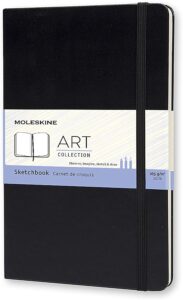
| Moleskine Art sketchbook | A hard-cover book for drawings you want to keep together; linked large format is 5 × 8.25 inches. |
Smooth Bristol for outlines and lettering
If you want a smooth page for lettering, graphic shapes or fine outlines, start by comparing smooth Bristol pads. Smooth and vellum are different finishes, so read the selected pad’s description instead of assuming all Bristol is smooth.
The Strathmore 300 Series option linked here is a 100 lb smooth pad with 20 sheets in the 9 × 12-inch size. Its retailer listing includes marker, pen and ink among the suggested uses. Check how evenly your paint covers a sample and whether it marks the reverse side before using both sides of a sheet.

View the Strathmore smooth Bristol pad on Amazon.
Mixed-media paper for a page with more than one medium
A mixed-media pad is worth considering if you combine marker lines with pencil, ink or light washes. You may prefer its slight texture to a very smooth drawing sheet. Try your usual combination on a spare page, especially if you will repeatedly cover the same area.
Canson describes XL Mixed Media as medium-grain paper sized for wet and dry media. The pad version is 160 gsm. The linked option is the 9 × 12-inch, 60-sheet wirebound pad. Select Mixed Media if that is the surface you want; the same product family includes other styles.
View the Canson XL Mixed Media pad on Amazon.
Hot-press watercolor paper for wet work
If you plan to combine Posca details with a watercolor wash, compare watercolor papers. Pay attention to the finish as well as the weight. A textured watercolor sheet and a smooth hot-press sheet can give your drawing quite different surfaces.
The linked Arches pad is the 10 × 14-inch hot-press, 300 gsm version. Arches’ Aquarelle specifications identify the range as cotton paper for watercolor and other wet techniques. Its pad-and-block guide also distinguishes the finishes and bindings. Check that you are buying a pad if you want that format, rather than a block glued around its edges.

View the Arches hot-press watercolor pad on Amazon.
Canvas paper when you want texture
Canvas paper gives you a different look from smooth illustration paper. The texture becomes part of the drawing, so choose it because you want that effect. It would not be my first suggestion for small lettering that depends on a very even surface.
The Strathmore canvas-paper pad linked here is listed for oil or acrylic painting. It has 10 sheets of 115 lb paper in the 9 × 12-inch size. Make a small sample with the nib and technique you plan to use, and check how the lines look across the texture.

View the Strathmore canvas-paper pad on Amazon.
An art sketchbook for drawings you keep in a book
For a visual journal or a collection of drawings, binding and page color may matter as much as the paper’s weight. Check whether you want pages that tear out, a book that opens flat or a hard cover that protects the pages in your bag.
The linked Moleskine Art Plus sketchbook is the large black hard-cover version. Moleskine’s Art sketchbook specifications list ivory-colored, acid-free 165 gsm paper. The ivory page color will give a different background from bright-white paper. Test the back of a page as well as the drawing surface before deciding to work on both sides.
View the large Moleskine Art sketchbook on Amazon.
What about thin marker paper and tracing paper?
Marker paper can mean a thin layout sheet with an ink barrier. For example, Canson XL Marker is 70 gsm and semi-transparent. Canson describes its smooth surface and ink barrier, including suitability for alcohol or solvent markers. Those properties alone do not tell you how much wet paint or repeated nib work a sheet will tolerate. For large painted areas, I would start by comparing the drawing and wet-media options above.
Tracing paper serves a different purpose: seeing an image beneath the sheet or making a translucent overlay. It is not a necessary purchase for an ordinary Posca drawing. If your project specifically needs tracing paper, test paint coverage, drying and the sheet’s strength before committing to it.
Check a small sample before committing to a pad
On a spare sheet, make one thin line and a small filled shape. Let them dry, then add a second layer using your usual pressure. Check the surface for damaged fibers, look at the reverse side and see how flat the sheet stays. Repeat with any pencil or paint you plan to combine with the markers.
Compare the same drawing on two papers if you are unsure about texture. You do not need to buy every type in this list. Pick the finish and format that suit your project, then expand your paper collection only when a different technique calls for it.
Up Next: The Best Acrylic Paint Pens