
Crochet Hooks For Knife Hold And Pencil Grip
A crochet hook does not have to be labeled for knife hold or pencil grip to suit your hand. Both grips use the same tool; the useful differences are where your fingers rest, how the handle sits against your hand and how much space remains on the shaft for your stitches.
For a first comparison, try a Clover Soft Touch in the size your pattern needs. Its flatter handle gives you a different shape to compare with the rounded, cushioned Clover Amour. Prym’s small five-hook set is another option if you want a plastic hook with a shaped rubberized handle. None belongs exclusively to one grip.
Below, we compare those three options and explain what to check before buying a set. This guide uses manufacturer information and current retail listings checked on October 11, 2026; it does not claim hands-on testing.
As an Amazon Associate, we earn from qualifying purchases.
Knife Hold And Pencil Grip: What Changes?
The Craft Yarn Council’s crochet manual describes two common holds and suggests trying both to find the one you prefer. You do not have to change a comfortable grip just because a different one looks more common in a tutorial.
Knife hold
Hold the hook overhand, with the handle beneath your palm, as you would hold a table knife. Your thumb and fingers guide the hook. Notice whether the end of the handle reaches far enough into your hand and whether a wide or rounded handle gives you the space you want.
A thicker handle can be worth comparing, but bigger is not automatically better. If you hold the hook close to its head, a handle that begins too far forward may leave less exposed shaft than you prefer. Check that transition as well as the overall length.
Pencil grip
Hold the hook between your thumb and index finger as you would a pencil, with your other fingers supporting it. Compare the thumb-rest position, the shape against your fingers and how readily you can turn the hook to catch the yarn.
A flatter rest may suit the way you place your fingers, while a rounded cushion may feel better to someone else. Try the actual hook rather than buying solely because a product description assigns it to pencil grip.
Compare Three Crochet Hook Options
| Hook or set | What to compare |
|---|---|
| Clover Soft Touch, 4 mm single hook | Flatter plastic handle with a soft cushion. Compare one hook before buying several; choose the millimeter size your pattern requires. |
| Clover Amour 3672, ten-hook set | Aluminum hooks with rounded elastomer handles and a thumb rest. Ten sizes from 2.25 to 6 mm; an option for either grip. |
| Prym Ergonomics, small five-hook set | Plastic hooks with shaped rubberized grips. Sizes 3.5, 4, 4.5, 5 and 6 mm; a different material and handle shape to compare. |
The linked Soft Touch is a single 4 mm hook. The other two links are sets. Compare the included sizes before comparing the package price, and check the selected variant at checkout.
1. Clover Soft Touch: A Single Hook To Compare

The current Clover 1007/G listing is a 4 mm metal hook with a plastic handle and built-in soft cushion. Its relatively flat handle is the main reason to compare it with a rounder handled hook, whichever grip you use.
Buying one hook lets you judge that shape before committing to a full set. Start with the size you need for a real project. A 4 mm hook is not a universal beginner size, and another size in the same range may have a separate listing.
Watch where your thumb lands on the cushion and whether the handle ends at a useful point in your hand. A soft-touch name describes the handle; it does not establish that it will suit every person.
Check the 4 mm Soft Touch hook on Amazon
2. Clover Amour: A Rounded Handle For Either Grip
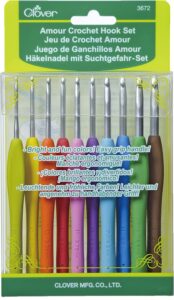
Clover describes Amour as having a rounded handle with a flat thumb-rest area, designed to accommodate both overhand and pencil holds. That makes it a useful comparison if you want a cushioned handle without committing to a grip-specific label.
The manufacturer’s 3672 set contains ten aluminum hooks with elastomer handles: 2.25, 2.75, 3.25, 3.5, 3.75, 4, 4.5, 5, 5.5 and 6 mm. The colors identify sizes, but read the millimeter marking when matching a pattern.
Compare this set if you already use several of those sizes. It does not include every size in Clover’s wider Amour range, so check separately if your next project calls for a larger hook.
Check the ten-hook Amour set on Amazon
3. Prym Ergonomics: Plastic Hooks With Shaped Grips

Prym’s small set uses synthetic hooks and rubberized grips, rather than an exposed metal hook with a separate cushioned handle. Compare it if you want to try that material and the gradual transition between shaft and handle.
The manufacturer’s small set contains five sizes: E/3.5 mm, G/4 mm, 7/4.5 mm, H/5 mm and J/6 mm. The current linked Amazon listing is this small set; the large set is a different selection.
It may be worth comparing for either grip, depending on where your hand rests. Before ordering, check that these five sizes cover your projects. The set does not include 5.5 mm or hooks below 3.5 mm.
Check the small Prym set on Amazon
What To Check Before Buying
Match the hook size first
Use the millimeter size specified in your pattern as your starting point and follow its gauge instructions. Letters can differ between size systems and brands. In the Prym small set, G is 4 mm; the original KOKNIT listing used G for 4.5 mm. Read the actual measurement rather than assuming the letter settles it.
Compare the working shaft and handle separately
The shaft is the area where loops sit; the handle is the part you hold. A handle that feels appealing in the package can still leave less room than you want for a particular stitch. Check the space between the head and the beginning of the grip, especially if you hold the hook close to the head.
Hook-head and throat shapes also differ. Our inline versus tapered hook guide explains those terms. A shape label alone does not tell you which grip to use or how even your finished stitches will be.
Try one size before buying a large set
If you can handle a shop sample, try both grips and notice where your fingers actually land. If you are buying online, check the return terms and consider a single hook in a size you use often. That is a more useful first comparison than collecting a wide range of sizes you do not yet need.
For a gift, check the recipient’s existing hooks and patterns. A set duplicates some sizes they may already own; one missing size or a different handle shape may be the more useful addition.
Questions About Grip And Hook Choice
Do I need separate hooks for knife and pencil grip?
Usually the useful comparison is the handle shape and where it meets your fingers. Clover explicitly describes Amour as suitable for both holds. If your current hook works with your grip and pattern, the grip name alone is not a reason to replace it.
Is one grip always faster?
This guide does not establish a speed advantage for either grip. Try both if you are learning, then use the hold that lets you work comfortably and control the yarn. You do not have to switch because another crocheter prefers a different hold.
Will an ergonomic hook prevent hand or wrist pain?
A handle’s shape, material and cushion are features to compare, not a promise of pain-free crocheting. Choose by the actual fit rather than treating an ergonomic label as a guarantee.
Related Crochet Hook Guides
Compare ergonomic crochet hook designs
Interchangeable crochet hook sets